
Table of Contents
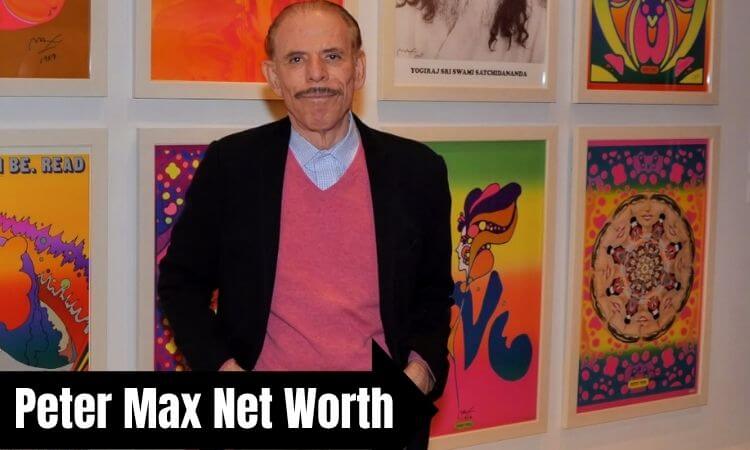
Peter Max Net Worth: How the Legendary Artist Built a $100 Million Fortune
Peter Max Net Worth: $100 Million
Last Updated: September 17, 2026
Peter Max was a German-American artist, illustrator, graphic designer, and businessman whose colorful artwork became one of the most recognizable visual styles of the 1960s and beyond. At the time of his death in September 2026, Peter Max had an estimated net worth of $100 million.
Known for his psychedelic colors, cosmic imagery, smiling suns, rainbows, stars, planets, flowers, American flags, and expressive human figures, Max became far more than a traditional painter. He transformed his artwork into a massive commercial enterprise, licensing his designs to companies that produced everything from posters and clothing to clocks, dishes, bedding, glassware, stationery, airplanes, and cruise ships.
His commercial success was unusual in the fine-art world. Rather than restricting his work to galleries and private collectors, Max believed art could be enjoyed by ordinary people. His designs reached millions of people through affordable posters and consumer products, making his artwork part of everyday American culture.
Max’s fortune was therefore built through several different streams, including original paintings, prints, licensing agreements, commercial commissions, intellectual property, merchandise, corporate relationships, and his long-running art business.
His career was also filled with major public projects. He became an official artist for events including the 1994 FIFA World Cup, the Olympics, the Super Bowl, the Indianapolis 500, the World Series, and other major cultural and sporting events. His artwork appeared on postage stamps, public installations, airplanes, cruise ships, posters, and numerous commercial products.
Peter Max died at a Manhattan hospital in September 2026 at the age of 88. His son Adam confirmed his death, and reports said Max had suffered from advanced dementia for years.
But how did a boy born in Berlin, who spent part of his childhood in Shanghai and later moved to the United States, become one of America’s best-known commercial artists?
Here’s a detailed look at Peter Max’s net worth, career, business empire, artwork, major projects, personal life, and lasting legacy.
Peter Max Net Worth
Peter Max had an estimated net worth of $100 million at the time of his death.
Unlike celebrities whose fortunes are primarily based on salaries, movie contracts, music royalties, or business ownership, Max’s wealth was closely connected to the value and commercial use of his artwork.
His financial success came from a combination of:
- Original paintings
- Limited-edition prints
- Posters
- Art licensing
- Consumer products
- Commercial illustrations
- Corporate commissions
- Public art projects
- Event commissions
- Airline and cruise-ship artwork
- Intellectual-property rights
- Art studio operations
- Gallery sales
- Collectible artwork
- Brand partnerships
This makes estimating his wealth more complicated than simply adding up annual income.
A successful painting could generate money when originally sold, but Max’s imagery could also continue generating revenue through licensing, reproductions, prints, merchandise, and other commercial applications.
That business model helped transform him from a successful commercial illustrator into a multimillionaire artist with a global brand.
His commercial reach was extraordinary. During the height of his popularity, his artwork was licensed across dozens of product categories and was reportedly associated with more than 70 companies.
His financial success became so notable that Life magazine famously placed him on its cover with the headline “Peter Max: Portrait of the Artist as a Very Rich Man.”
The description was fitting because Max had managed to accomplish something relatively unusual: he turned a recognizable artistic style into a commercial empire.
DO NOT MISS: How much is Clay Aiken Net Worth?
Who Was Peter Max?
Peter Max was born Peter Max Finkelstein on October 19, 1937, in Berlin, Germany.
He became one of the most recognizable American artists associated with psychedelic and pop art.
His work is often identified by its:
- Bright colors
- Cosmic imagery
- Stars
- Planets
- Rainbows
- Flowers
- Suns
- Human profiles
- Bold outlines
- Repeated patterns
- Vibrant typography
- Optimistic themes
Although his work became strongly associated with the 1960s counterculture, Max’s career lasted for more than half a century.
His art eventually moved beyond the psychedelic era.
He created portraits, patriotic paintings, environmental artwork, celebrity images, public installations, event posters, commercial designs, and large-scale commissions.
The U.S. Department of State describes space and astronomy as two important sources of inspiration for Max’s work, while his official biography notes that his early experiences in Shanghai, Paris, Israel, and New York helped shape his artistic worldview.
Max’s career was particularly interesting because he existed between several worlds.
He was simultaneously:
- A fine artist
- A commercial illustrator
- A graphic designer
- A pop-culture personality
- A businessman
- A licensing entrepreneur
- A public artist
That combination played a major role in building his fortune.
Peter Max’s Early Life
Peter Max was born in Berlin in 1937.
His parents were Jakob and Salla Finkelstein. His family was Jewish, and the rise of Nazi Germany forced them to leave Europe while Peter was still very young.
In 1938, his family moved to Shanghai, China.
The move exposed Max to a dramatically different environment from the Europe he had left behind.
Shanghai was a major international city filled with different cultures, languages, artistic traditions, architecture, music, movies, and religious influences.
For the young Max, it became an important part of his creative development.
His official biography describes Shanghai as a place where he encountered Asian culture, European influences, American comic books, jazz radio, and Hollywood movies.
Max also became fascinated by Buddhism and the visual patterns surrounding him.
The combination of Eastern culture and Western popular culture would later become visible in his art.
His interest in astronomy also became increasingly important.
Max was fascinated by the universe, planets, stars, and space.
That fascination eventually became one of the defining elements of his famous Cosmic ’60s imagery.
Instead of treating art and astronomy as completely separate interests, Max eventually combined them.
The result was a visual style that seemed to place human beings inside a colorful, dreamlike universe.
From Shanghai to Israel
Max spent roughly a decade in Shanghai.
In 1948, his family moved to Haifa, Israel.
The change once again exposed him to a new culture.
While living in Israel, Max continued developing his artistic abilities.
He studied art and became particularly interested in color.
He also pursued his interest in astronomy.
According to biographical material from the Peter Max studio, his fascination with the cosmos became especially strong during his teenage years. He studied astronomy while continuing his artistic education.
The combination became central to his future career.
Max wasn’t simply interested in making colorful pictures.
He wanted to explore the relationship between color, movement, spirituality, nature, and the universe.
That philosophy would eventually become recognizable in almost everything he created.
YOU MAY LIKE THIS: Raheem Sterling Net Worth: Salary, Career, Earnings, Endorsements, and Lifestyle
Paris and the Louvre
Before permanently settling in the United States, Max’s family spent several months in Paris.
The experience was important to his artistic education.
His mother encouraged his artistic development and arranged for him to take sketch classes at the Louvre.
Paris introduced Max to European art history and traditional artistic techniques.
This was particularly important because his later career became associated with a style that looked radically different from traditional academic painting.
Before becoming famous for psychedelic imagery, Max had studied realism.
He learned fundamentals such as:
- Anatomy
- Figure drawing
- Composition
- Draftsmanship
- Color
- Painting technique
Those traditional skills gave him a foundation that he later combined with abstraction and avant-garde influences.
His career therefore did not begin with the psychedelic art for which he became famous.
He first developed a strong understanding of conventional art.
Moving to America
In 1953, Max and his family immigrated to the United States.
They eventually settled in Brooklyn, New York.
Max was approximately 16 years old.
New York immediately exposed him to another completely different visual environment.
Broadway billboards, skyscrapers, advertising, comic books, magazines, museums, galleries, and the city’s rapidly changing cultural scene all became part of his experience.
He attended Lafayette High School and later continued his formal artistic training.
In 1956, Max began studying at the Art Students League of New York.
There he studied realism under Frank J. Reilly.
The official Peter Max biography notes that he later became interested in avant-garde approaches and continued his education at the School of Visual Arts.
His training would become an important part of his eventual success.
Although the art world later associated Max with spontaneous psychedelic paintings, his early education gave him a disciplined understanding of drawing and composition.
Peter Max’s First Commercial Success
Max’s first major professional success came through commercial art.
In 1962, he and fellow artist Tom Daly established a Manhattan studio.
The studio focused on:
- Graphic design
- Book covers
- Advertising
- Album artwork
- Commercial illustration
One important early assignment involved a Riverside Records album featuring blues pianist Meade Lux Lewis.
Max’s artwork for the album earned a gold medal from the Society of Illustrators.
That recognition helped establish him as a talented commercial artist.
The studio subsequently received numerous awards.
For a young artist, commercial illustration offered an important advantage.
Instead of relying exclusively on gallery sales, Max could make money through professional assignments.
More importantly, commercial work taught him how powerful recognizable imagery could be.
That lesson became extremely important later.
Max eventually realized that an artist could create a visual identity that consumers would recognize immediately.
He would turn that realization into one of the most successful artist-branding strategies of the twentieth century.
The Birth of Cosmic ’60s
The defining moment in Peter Max’s career came during the 1960s.
American culture was changing rapidly.
Young people were embracing new music, fashion, spirituality, environmentalism, alternative lifestyles, and experimental forms of art.
Psychedelic music and visual culture were becoming increasingly popular.
Max’s artwork fit perfectly into that environment.
His imagery incorporated:
- Exploding colors
- Stars
- Suns
- Planets
- Rainbows
- Flowers
- Human faces
- Repeating patterns
- Curved lines
- Cosmic landscapes
The result became known as his Cosmic ’60s style.
It was colorful, optimistic, energetic, and immediately recognizable.
According to the Peter Max Studio, his fascination with space and art came together during this period, producing the imagery that eventually became associated with his name.
His artwork began appearing on posters and other products.
Suddenly, people weren’t simply buying an illustration.
They were buying the Peter Max look.
That distinction was extremely important to his future wealth.
How Peter Max Became Famous
Max’s popularity grew rapidly during the late 1960s.
His posters became especially popular among young Americans.
College dormitories, bedrooms, music shops, boutiques, and other spaces began displaying his work.
His art was closely associated with the cultural atmosphere surrounding the era.
Critics and journalists began describing Max’s visual influence in relation to the musical influence of the Beatles.
The comparison helped elevate him beyond the traditional world of commercial illustration.
Max became a cultural celebrity.
His artwork wasn’t simply something people viewed in galleries.
It became part of the environment around them.
This widespread exposure dramatically increased his commercial potential.
Max also became a television personality.
He appeared on programs such as The Ed Sullivan Show and The Tonight Show.
His live drawing performances became part of his public image.
He could create large drawings rapidly, sometimes using both hands simultaneously.
This combination of artistic talent and showmanship made him memorable.
Peter Max and Mass-Market Art
One of the most important decisions of Max’s career was his willingness to make art accessible to ordinary consumers.
Traditional fine-art markets often emphasize unique paintings sold to collectors.
Max went in a different direction.
He allowed his imagery to appear on products that ordinary consumers could purchase.
This included:
- Posters
- Clothing
- Clocks
- Towels
- Bedding
- Glassware
- Dishes
- Stationery
- Shoes
- Home products
- Other merchandise
The strategy was simple.
Companies handled production and distribution.
Max provided the artwork and brand.
The companies could sell products at scale, while Max earned money through licensing arrangements.
This created a business model capable of producing much more revenue than selling a limited number of original paintings.
It was essentially the creation of an artist licensing empire.
Peter Max’s Licensing Empire
Max became one of the most successful examples of an artist turning a visual style into a recognizable commercial brand.
At the peak of his early fame, his designs were reportedly associated with more than 70 companies and numerous product lines.
His artwork appeared on products that could be found in homes across America.
General Electric, for example, worked with Max on colorful clocks.
His imagery subsequently spread across many other consumer categories.
This approach had two major financial benefits.
First, it increased the number of people exposed to his work.
Second, it allowed Max to earn money from the same artistic concepts repeatedly.
An original painting could be sold once.
A licensed design could potentially appear on thousands or millions of products.
That distinction helps explain how Max’s net worth eventually reached an estimated $100 million.
Why Peter Max Was Criticized
Max’s commercial success wasn’t universally celebrated by traditional art critics.
Some critics viewed the mass reproduction of his artwork as a form of commercialization that reduced the exclusivity normally associated with fine art.
But Max had a different philosophy.
He believed art should be available to ordinary people.
Instead of seeing commercialization as something that weakened art, he viewed mass exposure as a way of expanding art’s audience.
His posters allowed people who could never afford a major original painting to own a piece of his visual world.
That philosophy became one of the defining characteristics of his career.
His art was meant to be seen.
And eventually, it was seen almost everywhere.
Peter Max and the Environment
Max’s interests weren’t limited to psychedelic imagery.
Environmentalism became an important part of his work.
In the 1970s, he was commissioned by the U.S. Postal Service to create artwork for Expo ’74, an environmentally themed World’s Fair in Spokane, Washington.
His design featured his recurring Cosmic Jumper figure and promoted environmental awareness.
This project demonstrated how his art could be used to communicate public messages.
His imagery was colorful and accessible enough to work outside traditional gallery settings.
That versatility would continue throughout his career.
Peter Max and the Statue of Liberty
The Statue of Liberty became one of Peter Max’s most recognizable recurring subjects.
Max began creating Liberty-themed artwork during America’s Bicentennial period.
The subject became deeply connected with his artistic identity.
The U.S. Department of State notes that Max began an ongoing Statue of Liberty series in 1976 and later created large Liberty paintings for the White House lawn. He also supported efforts connected to the statue’s restoration.
His Liberty paintings combined several elements that were central to his work:
- Patriotism
- Color
- Optimism
- American symbolism
- Pop-art accessibility
Over the years, he painted the Statue of Liberty in numerous styles and colors.
The subject became almost as closely associated with Max as his cosmic imagery.
Did Peter Max Create Yellow Submarine?
One of the most common misconceptions about Peter Max is that he designed the artwork for the Beatles’ animated movie Yellow Submarine.
He did not.
The film’s visual design was created under the direction of German illustrator Heinz Edelmann.
The confusion is understandable because Edelmann’s psychedelic visual style and Max’s artwork shared some similarities.
Both became associated with the colorful visual culture of the late 1960s.
Max did, however, have real connections with Beatles-related culture and later produced Beatles-associated artwork.
He also painted a Baldwin piano for a charity project involving Ringo Starr and created portrait work associated with Paul McCartney.
So while Max did not create Yellow Submarine, his artistic identity became strongly connected with the same cultural era.
Peter Max Takes a Break From Fame
By the early 1970s, Max had become almost too successful.
His artwork was everywhere.
Products carried his imagery.
Posters filled bedrooms.
Television audiences recognized him.
Companies wanted to work with him.
But the sheer scale of his popularity eventually became creatively exhausting.
Max reportedly became concerned that his own style was becoming repetitive.
He withdrew from some of the intense commercial activity surrounding his brand and spent more time painting privately.
This period allowed him to reconsider his relationship with commercial art.
Rather than abandoning his recognizable style completely, he gradually moved toward more traditional painting while maintaining the vivid colors and cosmic elements that had made him famous.
His later work therefore combined the commercial iconography of his earlier years with a greater emphasis on painting.
Peter Max’s Portraits
Max eventually expanded his subject matter.
He painted portraits of musicians, actors, political figures, cultural icons, and other prominent personalities.
His subjects included people from the entertainment industry and American public life.
He also created portrait series connected with major cultural anniversaries.
In 2015, for example, he produced paintings celebrating the centennial of singer Frank Sinatra.
His work was also associated with musicians such as Mick Jagger and Paul McCartney.
These projects demonstrated that Max could apply his visual language to recognizable personalities without abandoning his signature style.
Peter Max and the 1994 World Cup
Max’s international profile continued growing decades after his initial 1960s breakthrough.
In 1994, he was named an official artist for the FIFA World Cup, which was hosted in the United States.
He created commemorative artwork for the tournament.
This was another example of Max’s ability to work on enormous cultural events.
His style was particularly suited to major events because it could communicate excitement, movement, optimism, and celebration without requiring viewers to understand traditional fine-art concepts.
Peter Max and Woodstock ’99
In 1999, Max received another enormous commission.
Woodstock organizer Michael Lang hired him to create a large stage design for Woodstock ’99.
The project gave Max another opportunity to place his artwork on a massive physical scale.
Instead of a canvas hanging inside a gallery, his artwork could become part of an enormous public environment.
That ability to scale his artwork became a recurring theme throughout his career.
Peter Max’s Boeing 777
One of the most visually striking examples of Max’s commercial work came in 2000.
Continental Airlines unveiled a Boeing 777 covered in Peter Max artwork as part of New York City’s millennium celebrations.
The airplane effectively became a flying piece of pop art.
For Max, the project represented exactly what had made his career so unusual.
His artwork had moved far beyond paper and canvas.
It could cover:
- Buildings
- Vehicles
- Aircraft
- Ships
- Public spaces
- Consumer products
His designs had become a visual language that could be applied almost anywhere.
Peter Max and Cruise Ships
Max’s relationship with transportation-related artwork continued later in his career.
Norwegian Cruise Line commissioned him to create artwork for the hull of the Norwegian Breakaway.
The project transformed an enormous ship into a colorful floating canvas.
This was another example of how Max’s artistic brand could generate commercial value through large-scale commissions.
His artwork had already appeared on an aircraft.
Now it could dominate the exterior of a cruise ship.
Peter Max’s Major Event Commissions
Over his long career, Max became associated with numerous major events.
He served as an official artist for or created artwork connected with events such as:
- The Olympics
- The Super Bowl
- The FIFA World Cup
- The Indianapolis 500
- The World Series
- Woodstock
- Major music-industry events
His ability to work with large organizations became an important component of his commercial success.
Major commissions not only generated income but also gave his artwork enormous exposure.
Peter Max’s Art Business
A major part of Max’s later career was organized through ALP Inc.
The company name represented the names of Max and his children, Adam and Libra.
Court records later described ownership arrangements involving the family.
ALP handled aspects of the Peter Max art business, including production, marketing, licensing, and commercialization.
This business structure helped separate the artistic side of Max’s career from the corporate machinery needed to distribute and sell his work.
The scale of the operation was considerable.
Max’s business wasn’t simply a small artist’s studio selling paintings.
It was a commercial enterprise involving artwork, intellectual property, licensing, inventory, marketing, and distribution.
That distinction is important when examining his $100 million estimated fortune.
How Much Money Did Peter Max Make From His Art?
The exact amount Peter Max earned each year varied considerably.
Artists don’t usually receive a fixed salary in the same way actors or employees do.
Instead, their income can come from:
- Artwork sales
- Licensing
- Commissions
- Prints
- Royalties
- Gallery arrangements
- Commercial partnerships
- Intellectual-property rights
Max had all of these potential revenue streams.
One particularly revealing figure from the information surrounding his later business affairs is that his studio reportedly generated more than $30 million in profit in 2018.
That doesn’t mean Max personally received $30 million that year.
Business profits can be distributed, retained, reinvested, or divided among owners and other interests.
However, the figure illustrates the extraordinary commercial scale of his operation.
The Value of Peter Max’s Artwork
Determining the value of Max’s entire art collection is complicated.
There were:
- Original paintings
- Drawings
- Prints
- Posters
- Licensed designs
- Unfinished works
- Commercial pieces
- Archived materials
The market value of individual works varied considerably.
Auction results for Peter Max works could be far below the values associated with his enormous commercial business.
This is an important distinction.
An artist can have a huge commercial brand without every original painting selling for tens of millions of dollars.
Max’s wealth was connected to the overall business ecosystem surrounding his art.
That included the value of his intellectual property and the ability to commercialize his recognizable imagery.
Why Peter Max’s Net Worth Is Difficult to Calculate
The reported $100 million figure should be understood as an estimate rather than a publicly audited balance sheet.
There are several reasons.
First, private companies do not always disclose complete financial information.
Second, artwork values can fluctuate.
Third, intellectual property can be difficult to value.
Fourth, ownership structures can involve multiple family members and business entities.
Fifth, legal disputes can affect control over assets.
Max’s later years involved extensive disagreements surrounding his finances, artwork, company, guardianship, and intellectual property.
As a result, it is difficult to determine exactly how much money he personally controlled at any particular moment.
Nevertheless, the $100 million estimate reflects the enormous commercial value that had accumulated around his name and artwork.
Peter Max’s Dementia and Guardianship Disputes
During his later years, Max’s health deteriorated significantly.
Reports following his death stated that he had suffered from advanced dementia for years.
As Max became less capable of managing his own affairs, control of his business and assets became a source of legal conflict.
His son Adam became involved in managing the business.
Disputes subsequently developed among family members, business associates, guardians, and others connected to Max’s estate and company.
The disagreements involved issues such as:
- Management of his business
- Artwork ownership
- Intellectual property
- Financial decisions
- Guardianship
- Personal care
- Company assets
The legal battles attracted attention because of the enormous value of Max’s artwork and business interests.
They also highlighted a broader issue faced by families of wealthy elderly artists: how to protect an artist’s assets and wishes when the artist is no longer able to manage complicated business affairs personally.
Peter Max’s Personal Life
Peter Max’s personal life was also complicated.
He married Elizabeth Ann Nance in 1963.
The couple had two children:
- Adam Max
- Libra Max
The marriage eventually ended in divorce.
In 1997, Max married Mary Balkin, who became known publicly as Mary Max.
The couple remained together during the later period of Max’s life.
Mary Max died in 2019.
Her death occurred during a difficult period involving legal and family disputes surrounding Peter Max’s health and business.
Max’s children later became important figures in discussions surrounding his estate and art business.
Peter Max’s Lifestyle
Despite his association with psychedelic art, Max’s personal lifestyle was not based around the stereotypical excesses often associated with the 1960s counterculture.
He was known for being a vegetarian and teetotaler.
Yoga, meditation, spirituality, nature, and astronomy were important influences on his worldview.
These interests were reflected in his art.
The colorful imagery wasn’t simply about creating something visually loud.
For Max, the universe, spirituality, nature, and human creativity were interconnected.
His paintings frequently attempted to communicate optimism and positive energy.
This was one reason his artwork remained recognizable even as popular culture changed.
Peter Max’s Philosophy About Art
Max believed strongly in accessibility.
He didn’t want art to belong only to wealthy collectors or museum visitors.
His posters and commercial products allowed ordinary people to own something connected with his artistic identity.
This philosophy helped explain his willingness to work with companies.
To Max, putting artwork on a clock or piece of clothing didn’t necessarily make it less meaningful.
Instead, it gave the art another way to reach people.
His commercial strategy was therefore closely connected with his artistic philosophy.
The more people who encountered his imagery, the larger his cultural impact became.
Peter Max and American Pop Culture
Peter Max’s influence reached far beyond the art world.
His imagery became part of the visual language of the 1960s.
His work appeared on:
- Posters
- Magazine covers
- Clothing
- Household items
- Album-related material
- Public installations
- Airplanes
- Cruise ships
- Stamps
- Event artwork
His influence remained visible long after the original psychedelic era ended.
Modern audiences who never experienced the 1960s could still recognize a Peter Max-style sun, rainbow, cosmic face, or colorful human profile.
That level of recognition is one reason his artwork remained commercially valuable for decades.
Peter Max’s Relationship With the Beatles
The Beatles and Peter Max became closely associated in popular imagination.
Critics frequently compared Max’s visual influence to the Beatles’ musical influence during the late 1960s.
Both became symbols of a generation that embraced colorful, experimental, and unconventional culture.
But it is important to separate Max’s actual work from myths surrounding the era.
Max did not design Yellow Submarine.
Nevertheless, his art existed within the same cultural ecosystem as the Beatles’ psychedelic period.
His posters and designs helped define the visual atmosphere of the era.
Peter Max and Celebrity Art
Max’s celebrity portraits became another important part of his later career.
He created portraits and artistic interpretations of musicians, entertainers, politicians, and other public figures.
His recognizable style allowed viewers to immediately identify the subject while also seeing the personality through Max’s visual vocabulary.
This approach worked particularly well with famous people.
A Peter Max portrait didn’t simply reproduce someone’s face.
It transformed the subject into a Max image.
That made the artwork instantly recognizable as his work.
Peter Max’s American Imagery
The Statue of Liberty was not the only American symbol Max embraced.
He also frequently painted:
- American flags
- Eagles
- Stars
- Presidents
- Patriotic figures
- American landscapes
- New York landmarks
This may seem surprising considering his association with counterculture.
But Max’s work eventually moved beyond the political and cultural divisions of the 1960s.
His patriotic artwork became a major part of his later identity.
The bright colors and optimistic tone made his American imagery distinctly his own.
Peter Max’s Legacy
Peter Max’s greatest achievement may have been his ability to make an individual artistic style recognizable to millions of people.
Many artists become famous among collectors.
Fewer become recognizable to the general public.
Max achieved both commercial and cultural recognition.
His imagery could appear in a museum, on a poster, inside a bedroom, on an airplane, or on a cruise ship.
That versatility was a major part of his success.
His work blurred the boundary between fine art and commercial art.
For traditionalists, that could be controversial.
For Max, it was the point.
He wanted art to be experienced.
Peter Max’s Influence on Commercial Artists
Max demonstrated that artists could build brands around their own visual identities.
Today, artists frequently license their artwork to:
- Fashion companies
- Home décor brands
- Technology companies
- Entertainment companies
- Collectible manufacturers
- Publishers
- Event organizers
Max was an early and highly visible example of this model.
He showed that an artist didn’t have to depend entirely on galleries.
An artist could become a brand.
That concept became increasingly common in later decades.
Peter Max’s Influence on Pop Art
Max is frequently associated with psychedelic art and pop art.
His work combined elements of:
- Pop art
- Psychedelia
- Op art
- Neo-Fauvism
- Graphic design
- Illustration
- Commercial art
His style wasn’t easily confined to one category.
That was part of its appeal.
His art was immediately understandable even when it was visually complex.
A person didn’t need formal art education to appreciate the bright colors and joyful imagery.
That accessibility helped him reach a huge audience.
The Business Lesson Behind Peter Max’s Fortune
Peter Max’s career offers an interesting example of how creative work can become a business.
His fortune wasn’t built simply because he was a talented painter.
Talent was the foundation.
But business strategy multiplied the value of that talent.
Max understood the importance of:
Recognition
People needed to recognize his work immediately.
Repetition
His imagery could be used across multiple products.
Licensing
Companies could commercialize his designs while he retained an artistic and financial interest.
Mass distribution
His work could reach millions of consumers.
Brand identity
The Peter Max name became part of the value of the product.
This combination helped him build a fortune estimated at $100 million.
What Made Peter Max’s Art So Valuable?
Several factors contributed to the enduring appeal of his artwork.
1. A recognizable visual style
A Peter Max painting could often be identified without seeing the signature.
2. Cultural association
His imagery became strongly connected with the 1960s.
3. Commercial exposure
His work appeared on countless products.
4. Historical significance
His art became part of the visual history of American popular culture.
5. Collectibility
Collectors could purchase everything from inexpensive prints to original works.
6. Celebrity connections
His portraits of famous people expanded his audience.
7. Public commissions
Major projects kept his name visible across generations.
Peter Max’s Final Years
Peter Max’s final years were very different from the energetic period when he appeared on television and produced artwork at extraordinary speed.
His health had deteriorated significantly.
Dementia affected his ability to manage his career, and control of his business became increasingly complicated.
Despite these difficulties, the Peter Max name remained commercially important.
His existing artwork continued circulating through galleries, collectors, exhibitions, prints, and commercial channels.
His legacy therefore continued even as his personal involvement declined.
Peter Max’s Death
Peter Max died in September 2026 at the age of 88.
Reports said he died at a hospital in Manhattan after years of declining health. His son Adam confirmed his death.
His death marked the end of a career that had lasted more than six decades.
From his early childhood in Europe and Asia to his rise as a commercial illustrator in New York, his story was remarkably international.
He went from being a young immigrant artist to becoming one of America’s most recognizable visual artists.
Peter Max Net Worth at the Time of His Death
At the time of his death, Peter Max’s estimated net worth was $100 million.
That fortune represented decades of artistic and commercial success.
His wealth was connected to:
- Original artwork
- Art collections
- Prints
- Licensing
- Commercial commissions
- Intellectual property
- Business interests
- Brand value
- Art studio operations
Because much of his wealth was tied to artwork and private business interests, the exact figure could not be independently confirmed through a simple public financial statement.
Still, the $100 million estimate provides a useful picture of the scale of the empire he built.
Peter Max Net Worth Over the Years
Peter Max’s wealth grew alongside the expansion of his art business.
During the 1960s, his income initially came primarily from commercial illustration and poster sales.
As his popularity increased, licensing became increasingly important.
During the 1970s and 1980s, his imagery became a major commercial brand.
In later decades, large-scale commissions, original artwork, gallery relationships, licensing, and public projects continued generating value.
By the 2000s and 2010s, the business surrounding his artwork had become a substantial operation.
The reported profitability of his studio in 2018 demonstrated that his commercial empire remained significant even decades after his original breakthrough.
Why Peter Max Was More Than a Painter
Calling Peter Max simply a painter doesn’t fully explain his career.
He was also:
- An illustrator
- A graphic designer
- A commercial artist
- A licensing entrepreneur
- A brand builder
- A television personality
- A public artist
- A cultural figure
His success came from combining all of these roles.
He understood that an image could be more than a painting.
It could become a product.
It could become a logo.
It could become a poster.
It could become a plane.
It could become a cruise ship.
It could become a national symbol.
That expansive approach was central to his financial success.
FAQS
What was Peter Max’s net worth?
Peter Max had an estimated net worth of $100 million at the time of his death in September 2026.
How did Peter Max make his money?
Peter Max made money through artwork sales, prints, posters, licensing agreements, commercial commissions, public projects, intellectual property, merchandise, and his art business.
How old was Peter Max when he died?
Peter Max was 88 years old when he died in September 2026.
When did Peter Max die?
Peter Max died in September 2026. Reports following his death said he died at a Manhattan hospital after suffering from advanced dementia.
Where was Peter Max born?
Peter Max was born in Berlin, Germany, on October 19, 1937.
What was Peter Max famous for?
Peter Max was famous for his colorful psychedelic artwork, particularly his Cosmic ’60s imagery featuring stars, planets, rainbows, flowers, suns, and colorful human figures.
Did Peter Max create Yellow Submarine?
No. Peter Max did not create the artwork for the Beatles’ animated film Yellow Submarine. The film’s visual design was associated with German illustrator Heinz Edelmann.
Did Peter Max design products?
Yes. Max licensed his artwork for a huge range of products, including clocks, clothing, household goods, posters, stationery, and other merchandise.
Did Peter Max paint the Statue of Liberty?
Yes. The Statue of Liberty became one of Peter Max’s most recognizable recurring subjects. He began his Liberty series during America’s Bicentennial period and continued returning to the subject throughout his career.
What was Peter Max’s most famous style?
His most famous style was his colorful psychedelic Cosmic ’60s imagery, characterized by vivid colors, cosmic themes, stars, planets, suns, rainbows, flowers, and stylized human figures.
Was Peter Max a German-American artist?
Yes. Max was born in Berlin and later became an American citizen. His family fled Nazi Germany when he was a child, and he eventually settled in New York.
Where did Peter Max live as a child?
He spent much of his childhood in Shanghai, China, before his family later moved to Israel, Paris, and eventually New York.
Did Peter Max study art?
Yes. He studied at the Art Students League of New York and later pursued avant-garde interests at the School of Visual Arts.
Did Peter Max have children?
Yes. He had two children, Adam and Libra.
Was Peter Max married?
Yes. He was married to Elizabeth Ann Nance and later married Mary Balkin, known publicly as Mary Max.
What made Peter Max so successful?
His success came from combining artistic talent with commercial strategy. He created a recognizable visual identity and then expanded it through posters, licensing, consumer products, commissions, public art, and large-scale commercial projects.
Conclusion
Peter Max’s story is one of the most unusual success stories in modern American art.
Born in Berlin in 1937, he experienced several cultures before eventually settling in New York. His childhood in Shanghai, time in Israel and Paris, interest in astronomy, formal art education, and exposure to American popular culture all contributed to the artist he eventually became.
His breakthrough came during the 1960s, when his brightly colored Cosmic ’60s artwork perfectly matched the cultural atmosphere of the era.
But becoming a famous artist wasn’t enough.
Max understood how to turn recognition into a business.
He licensed his artwork to companies, allowing his images to appear on products that reached millions of people. His art eventually appeared on clothing, clocks, household products, posters, airplanes, cruise ships, postage stamps, public installations, and major event artwork.
That commercial strategy helped transform Peter Max from a successful artist into a multimillion-dollar brand.
His later career demonstrated that he was not simply an artist frozen in the 1960s. He continued producing portraits, patriotic artwork, public commissions, celebrity images, and event artwork for decades.
His life also contained difficult chapters. His later battle with dementia and the legal disputes surrounding his business and assets complicated the final years of his life.
Yet those challenges do not erase the enormous cultural impact he created.
Peter Max helped demonstrate that art could exist simultaneously in museums, homes, stores, magazines, airplanes, ships, and public spaces.
His artwork became instantly recognizable.
His colors became part of the visual memory of an era.
And his name became a commercial brand worth millions.
At the time of his death in September 2026, Peter Max’s estimated net worth was $100 million.
More importantly, his legacy extended beyond his fortune. His greatest achievement was creating an artistic language that millions of people could recognize almost instantly.
Stars, suns, rainbows, planets, Liberty figures, colorful faces, and explosive patterns became the visual vocabulary of Peter Max.
His art helped define the look of the 1960s, but his influence lasted far beyond that decade.
Peter Max proved that an artist could create something recognizable enough to become a cultural symbol—and business-savvy enough to turn that symbol into a multimillion-dollar empire.