
Table of Contents
Best AR & VR Devices in 2026
The world of Augmented Reality (AR) and Virtual Reality (VR) has evolved rapidly, and 2026 is shaping up to be a landmark year for immersive technology. From powerful mixed-reality headsets to lightweight AR smart glasses, today’s devices are smarter, more comfortable, and more practical than ever before.
Whether you are a gamer, content creator, professional designer, or someone curious about immersive tech, this guide covers the top AR/VR devices of 2026, explaining what makes each one worth considering and who it’s best for.
1. Apple Vision Pro
Apple Vision Pro redefines mixed reality by blending digital content seamlessly with the real world. It introduces spatial computing, allowing users to interact with apps using eye tracking, hand gestures, and voice commands.
Best for: Professionals, creatives, Apple ecosystem users
Key highlights:
- Ultra-high-resolution micro-OLED displays
- Advanced eye and hand tracking
- Strong focus on productivity, media, and immersive experiences
Limitations: Very expensive and limited availability in some regions
2. Meta Quest 3 / Quest 3S
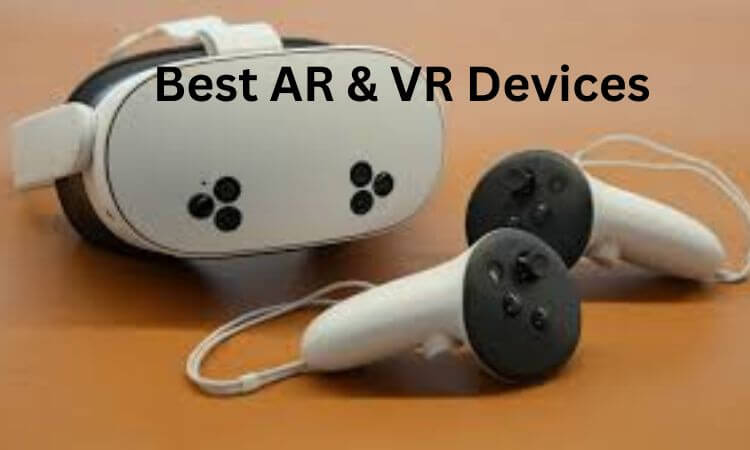
Meta Quest 3 remains one of the most popular AR/VR headsets in 2026 due to its balance of performance, price, and content availability. The Quest 3S offers a more affordable alternative while maintaining core features.
Best for: Casual users, gamers, beginners
Key highlights:
- Standalone headset (no PC required)
- Large game and app ecosystem
- Strong mixed-reality passthrough
Limitations: Display quality is not as premium as high-end devices
DO NOT MSS: Apple Vision Pro vs Meta Quest 4: Complete Comparison Guide
3. PlayStation VR2
PlayStation VR2 is designed exclusively for the PS5 and delivers a console-level VR gaming experience with impressive visuals and immersive feedback.
Best for: Console gamers
Key highlights:
- OLED displays with high refresh rates
- Adaptive triggers and haptic feedback
- Exclusive VR game titles
Limitations: Requires a PlayStation 5 and is not standalone
4. HTC Vive XR Elite
HTC Vive XR Elite combines powerful virtual reality with accurate augmented-reality passthrough, making it a strong choice for professional and enterprise use.
Best for: Business users, simulations, enterprise applications
Key highlights:
- High-quality mixed reality
- Modular and lightweight design
- Strong tracking and spatial awareness
Limitations: Smaller consumer content library
5. Varjo Aero (Professional-Grade VR)
Varjo headsets are known for delivering near-human-eye resolution, making them ideal for simulations, research, and industrial training.
Best for: Flight simulators, engineering, research
Key highlights:
- Exceptional visual clarity
- Eye-tracking technology
- Industry-grade accuracy
Limitations: Very expensive and requires a powerful PC
6. Pico 4
Pico 4 offers a solid standalone VR experience and is often considered an alternative to Meta Quest devices in certain markets.
Best for: Budget-conscious users seeking standalone VR
Key highlights:
- Lightweight and comfortable design
- Good resolution for the price
- Suitable for gaming and media
Limitations: Limited app ecosystem compared to Meta
7. Viture Luma Pro (AR Smart Glasses)
Viture Luma Pro focuses on portable AR experiences, turning everyday environments into personal cinema screens.
Best for: Media consumption, travel
Key highlights:
- Lightweight and stylish
- High-quality micro-OLED displays
- Ideal for watching movies and productivity
Limitations: Limited full spatial AR capabilities
8. Magic Leap 2
Magic Leap 2 is built specifically for enterprise-level augmented reality applications such as healthcare, manufacturing, and training.
Best for: Medical, industrial, and professional AR
Key highlights:
- Advanced spatial mapping
- Comfortable for long-term use
- Strong enterprise software support
Limitations: Not designed for gaming or casual use
9. Nreal Air (Consumer AR Glasses)
Nreal Air offers an accessible AR glasses experience that connects to smartphones, laptops, and gaming devices.
Best for: Casual AR users
Key highlights:
- Lightweight glasses form factor
- Affordable entry into AR
- Good for streaming and productivity
Limitations: Limited interactive AR features
10. Valve Index
Valve Index remains a favorite among PC VR enthusiasts thanks to its precise tracking and smooth performance.
Best for: Hardcore PC VR gamers
Key highlights:
- Excellent tracking accuracy
- High refresh rates
- Comfortable for long gaming sessions
Limitations: Requires external sensors and a powerful PC
Frequently Asked Questions (FAQs)
1. What is the difference between AR, VR, and MR?
- VR (Virtual Reality): Fully immersive digital environment
- AR (Augmented Reality): Digital elements overlaid on the real world
- MR (Mixed Reality): Interaction between real and virtual objects
2. Which AR/VR device is best for beginners?
Meta Quest 3 or Quest 3S is the best choice for beginners due to its ease of use, affordability, and large content library.
3. Are AR glasses better than VR headsets?
AR glasses are better for portability and everyday use, while VR headsets are better for full immersion, gaming, and simulations.
4. Do I need a powerful PC for AR/VR?
Not always. Standalone devices like Meta Quest 3 and Pico 4 work without a PC, while devices like Valve Index and Varjo require high-end computers.
5. Which AR/VR device is best for professional work?
Apple Vision Pro, HTC Vive XR Elite, Varjo, and Magic Leap 2 are best suited for professional and enterprise use.
Conclusion
The best AR and VR devices of 2026 offer something for everyone — from immersive gaming and cinematic experiences to professional design, training, and productivity. High-end users may gravitate toward Apple Vision Pro or Varjo, while mainstream users will find excellent value in Meta Quest 3. Meanwhile, AR smart glasses like Viture and Nreal point toward a future where immersive technology blends seamlessly into daily life.
As AR and VR continue to mature, choosing the right device depends on your budget, purpose, and ecosystem preference. One thing is certain: immersive technology in 2026 is no longer experimental — it’s practical, powerful, and here to stay.